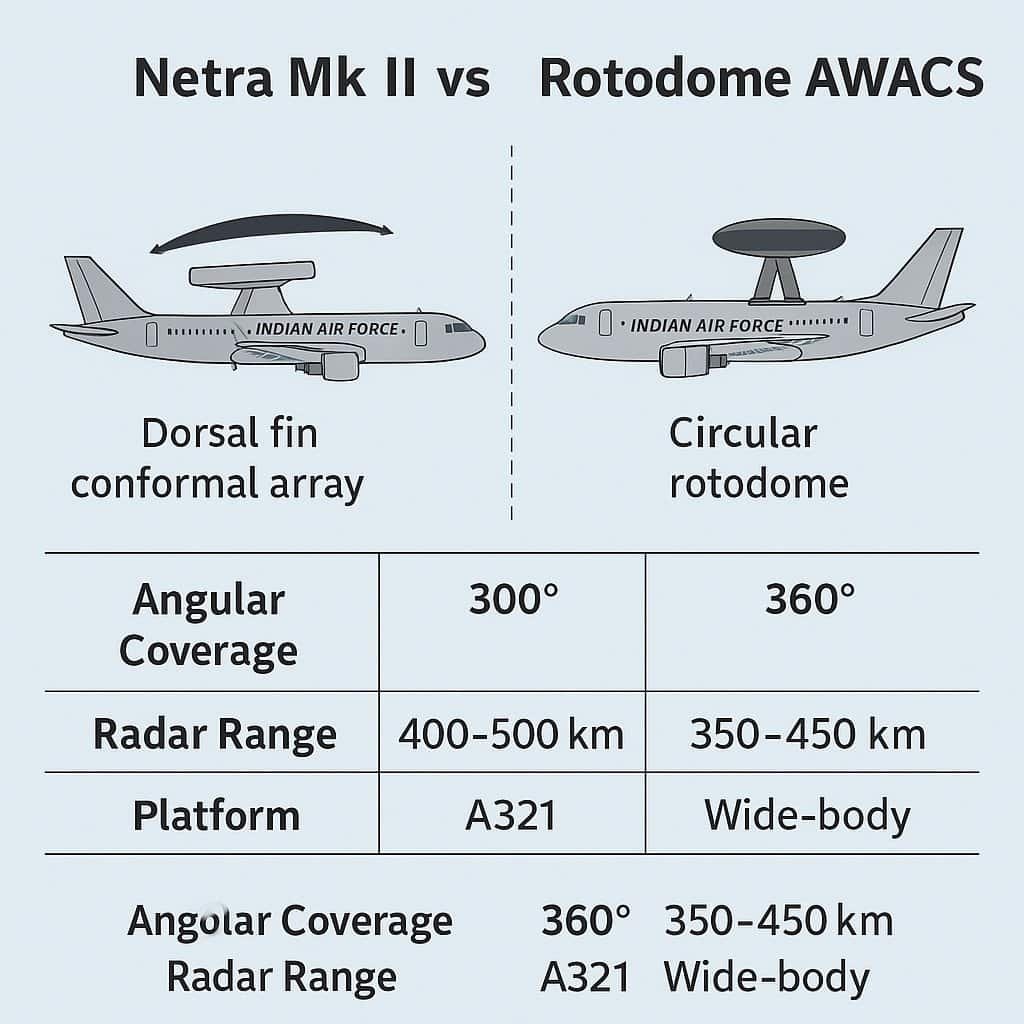

Netra Mk II vs DRDO rotodome has become the central debate in India’s airborne early warning and control (AEW&C) roadmap, highlighting the trade-offs between cutting-edge ambition and operational practicality. While DRDO’s 360° rotodome program promised comprehensive radar coverage, recent developments suggest the Indian Air Force (IAF) is prioritizing the Netra Mk II, a 300° solution that offers faster deployment, cost efficiency, and modern radar technologies.
The Rotodome Vision
DRDO’s 360° AWACS program was conceptualized as India’s answer to Western systems like the E-3 Sentry and China’s KJ-2000. Using a rotating radar dome mounted on a wide-body aircraft, the system would provide uninterrupted full-circle coverage, crucial for detecting low-flying aircraft and cruise missiles that might slip through sectoral radars.
Technically, the rotodome design is superior for persistent surveillance. However, the engineering challenges are formidable: structural reinforcement of the host aircraft, drag penalties, increased weight, higher fuel consumption, and greater maintenance complexity. With costs projected in excess of ₹25,000–30,000 crore for an initial fleet, the program risked long delays and spiraling budgets.
Netra Mk II’s Practical Advantage
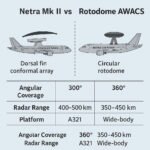
By contrast, the Netra Mk II, based on the Airbus A321, adopts a dorsal fin-mounted AESA array complemented by a nose-mounted radar. Together, these provide 300° coverage, leaving only a rear arc of about 60° uncovered. While this falls short of the rotodome’s full circle, the system compensates with range, endurance, and integration.
Key upgrades over Netra Mk I include:
- Radar Range: Enhanced AESA radar with gallium nitride (GaN) modules, capable of 400–500 km detection.
- Coverage: 300° arc sufficient for forward and flank sectors, with tactics designed to mitigate blind spots.
- Platform Endurance: A321 provides longer loiter times compared to smaller Embraer-based Mk I.
- Payload Capacity: Greater space for operators, electronic support measures, and communication relays.
The Cabinet has already cleared six Netra Mk II units at an estimated cost of ~₹19,000 crore, with deliveries expected from early 2030s. This ensures that the IAF can expand its AEW&C fleet within the decade, compared to uncertain timelines for the 360° rotodome.
Operational Sufficiency vs Theoretical Superiority
Critics argue that accepting 300° coverage risks leaving vulnerabilities. However, IAF planners highlight that AEW&C aircraft rarely operate in isolation. Combined with Phalcon AWACS mounted on IL-76, ground-based long-range radars, and networked fighters, the coverage gap can be mitigated operationally.
Moreover, in contested environments, survivability and sortie generation matter more than theoretical perfection. A slightly less comprehensive system that arrives on time may contribute more to air defence than an over-ambitious platform delayed indefinitely.
Cost and Risk Comparison
- Rotodome AWACS:
- Cost: ₹25,000–30,000 crore for a limited fleet.
- Risk: Long gestation, integration challenges, reliance on large imported airframes.
- Payoff: True 360° coverage, parity with advanced global systems.
- Netra Mk II:
- Cost: ~₹19,000 crore for six units.
- Risk: Sectoral coverage leaves theoretical blind arc.
- Payoff: Uses available Airbus platforms, indigenous AESA radar, faster delivery, modernised operator consoles.
From a risk-reward standpoint, Netra Mk II appears more viable in the medium term, especially as regional threats intensify.
Strategic Implications for India
The IAF’s preference for Netra Mk II signals a pragmatic shift: prioritizing capability in hand over capability on paper. It also highlights India’s broader Atmanirbhar Bharat push—indigenous AESA radar, DRDO-led integration, and collaboration with local industry.
Strategically, this positions India to field at least a dozen AEW&C aircraft (Phalcon, Netra Mk I, Netra Mk II) by the early 2030s, improving airspace awareness across two fronts.
For policymakers, the lesson is clear: defence planning must balance ambition with deliverability. While the 360° rotodome remains aspirational, Netra Mk II demonstrates how India can field credible, homegrown systems in realistic timelines