

Indian Defence News Today opened with a revelation that has stirred strategic circles: Chinese-backed media outlets have alleged that India is preparing for an Agni-V missile upgrade that could extend its range to nearly 8,000 km. If confirmed, this would mark a watershed moment in India’s nuclear deterrence capability, placing large parts of Asia, Europe, and Africa within reach. Against this backdrop, the day also witnessed crucial developments in indigenous fighter programs, unmanned systems, and international defence diplomacy. From the Tejas MkII prototype gaining momentum to HAL’s Hawk-i upgrades, private sector ambitions in AMCA, and a poignant farewell to the MiG-21, today’s Defence Roundup offers a sweeping look at India’s evolving military landscape.
Agni-V Upgrade Reports Trigger Chinese Scrutiny
The ICBM revelation carries the most immediate strategic weight. Reports from Chinese media suggest that India’s Agni-V program, already a cornerstone of its nuclear deterrent, is set for an extended-range variant capable of striking targets at 8,000 km. While New Delhi has remained characteristically silent, the implications are unmistakable.
Background: India has tested Agni-V multiple times with a range of 5,000–5,500 km, officially designating it an ICBM despite its “intermediate” classification by some.
Quick Fact: Analysts have long speculated that the missile’s three-stage design inherently supports longer ranges with minor modifications.
What it Means: Such an upgrade would significantly alter India’s deterrence posture vis-à-vis China, while also drawing renewed scrutiny from global non-proliferation regimes.
Tejas MkII Prototype Assembly Set to Begin by 2026
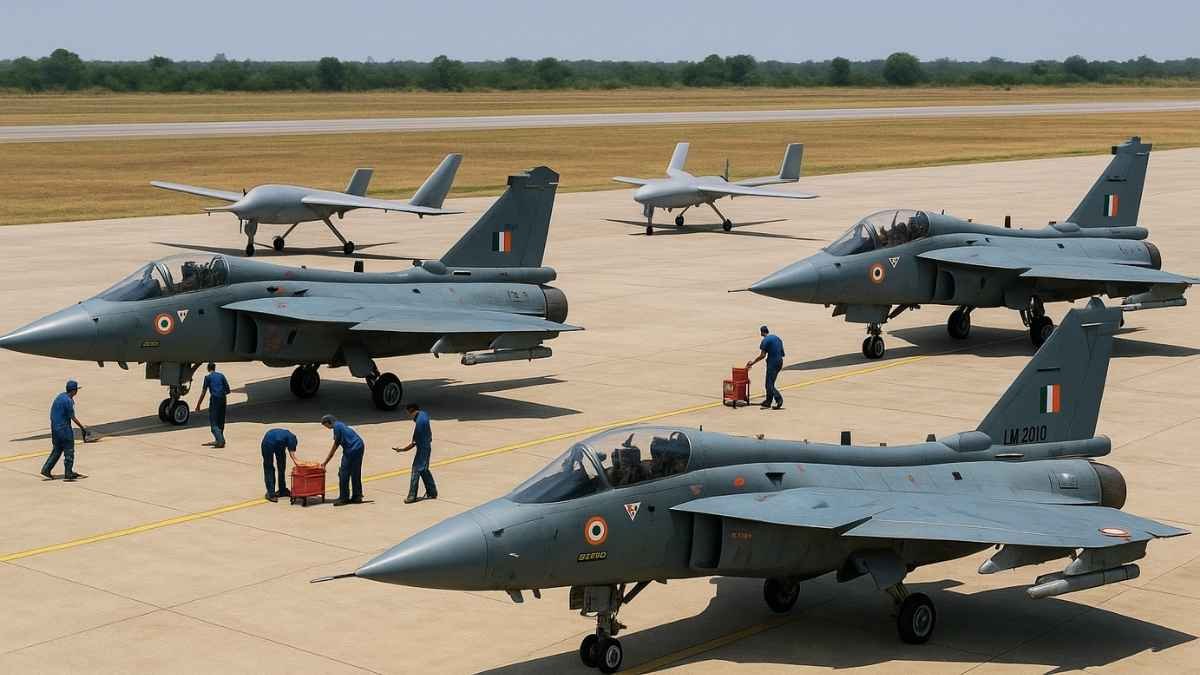
From missiles to fighters, the Tejas MkII program is gathering momentum, with the assembly of its second prototype slated to begin by 2026. This marks a critical juncture in India’s efforts to field a medium-weight fighter to replace legacy fleets like the Mirage 2000 and MiG-29.
Background: The Tejas MkII builds upon lessons from the Mk1A, offering higher payload capacity, longer range, and advanced avionics.
Quick Fact: The MkII’s maximum takeoff weight is projected at 17.5 tonnes, nearly double that of the Mk1.
What it Means: With IAF’s ambition to field 55 squadrons for a potential two-front war, the MkII is expected to be the backbone of India’s combat aviation fleet in the 2030s.
HAL’s Hawk-i AJT Showcases Enhanced Capabilities
HAL’s Hawk-i advanced jet trainer featured prominently, as the upgraded platform is being pitched for IAF induction. With enhanced avionics, indigenous mission computers, and compatibility for precision munitions, the Hawk-i blurs the line between trainer and light combat aircraft.
Background: India has over 120 Hawks in service, acquired from BAE Systems but increasingly upgraded indigenously.
Quick Fact: The Hawk-i can now integrate smart bombs and missiles, extending its role beyond pilot training.
What it Means: This shift represents a cost-effective way of supplementing frontline squadrons while also boosting indigenous aerospace capabilities.
Private Sector Shake-Up in AMCA Race
The AMCA program, India’s ambitious fifth-generation stealth fighter, is now facing a private sector shake-up. Reports suggest that Tata and Kalyani Group are exploring independent bids, sidelining HAL in some roles.
Background: HAL and ADA have so far led AMCA development, with private firms serving as suppliers.
Quick Fact: Private industry already contributes over a third of parts to the Tejas Mk1A.
What it Means: Competition could accelerate development and reduce monopolistic inefficiencies, but risks of fragmentation and delays must be carefully managed by the Ministry of Defence.
HAL Reaffirms Commitment to GE Engines for Tejas MkII
HAL has dismissed rumors that it may switch to French Safran engines for Tejas MkII, reaffirming that negotiations with GE are progressing as planned.
Background: India has long depended on GE engines, with Safran lobbying for entry into fighter propulsion.
Quick Fact: Safran co-developed the Shakti engines used in India’s helicopters but has not powered a frontline fighter.
What it Means: A clear commitment to GE ensures stability for the Tejas MkII program, though India’s broader goal of developing indigenous jet engines remains pressing.
HAL Eyes $1 Billion GE F404 Engine Pact for Tejas Mk1A
HAL is preparing for a major $1 billion deal with GE for the supply of F404 engines to power the 97 new Tejas Mk1A fighters ordered by the IAF.
Background: The Mk1A order, finalized earlier this year, is one of HAL’s largest contracts, aiming to fill squadron gaps until MkII induction.
Quick Fact: Thirteen Mk1As are already flying with interim CAT-B engines.
What it Means: Securing the F404 supply chain ensures India avoids bottlenecks in fighter production while simultaneously strengthening U.S.-India defence ties.
ADE Issues EOI for Turboprop Engines for HALE UAV Program
In unmanned systems, the Aeronautical Development Establishment (ADE) has issued an expression of interest for turboprop engines to power India’s HALE UAV program.
Background: India’s current UAV inventory includes Israeli Herons and indigenous TAPAS prototypes, but long-endurance capability remains a gap.
Quick Fact: HALE UAVs can loiter for over 48 hours at altitudes above 35,000 ft.
What it Means: Developing HALE UAVs indigenously would give India persistent surveillance and strike options, essential for monitoring both the northern and maritime frontiers.
India and Myanmar Hold Annual Defence Dialogue
On the diplomatic front, India and Myanmar held their annual defence dialogue, focusing on capacity building, training, and counter-insurgency cooperation.
Background: Myanmar shares a sensitive border with India’s northeast, where insurgent groups often exploit cross-border sanctuaries.
Quick Fact: India trains over 500 Myanmar defence personnel annually.
What it Means: By strengthening military ties with Naypyidaw, India seeks to counter Chinese influence in the region and safeguard its strategic interests in the Bay of Bengal.
Farewell to the Iconic MiG-21 in Chandigarh
A poignant moment came in Chandigarh with the farewell to the iconic MiG-21. Veterans and serving officers gathered to salute an aircraft that has been both celebrated and criticized in equal measure.
Background: The MiG-21 has served since 1963, fighting in every major Indian conflict but also earning the moniker “flying coffin” due to its high accident rate.
Quick Fact: India was the world’s largest operator of MiG-21s, with over 800 inducted.
What it Means: Its retirement marks the end of an era and the transition to indigenous fighters like Tejas, symbolizing India’s journey from dependence to self-reliance.
Conclusion
Together, these developments highlight the breadth of India’s defence activity today—from nuclear deterrence and indigenous fighter production to UAV expansion and regional diplomacy. The consistent thread across all updates is India’s push for greater technological autonomy while navigating complex geopolitical realities.
Conclusion: Today’s Defence Roundup reveals India’s twofold strategy: consolidating immediate readiness through deals and upgrades while preparing long-term breakthroughs like ICBM expansion and fifth-generation fighters. The day reflects not only India’s military modernization but also its rising confidence as a defence power.