
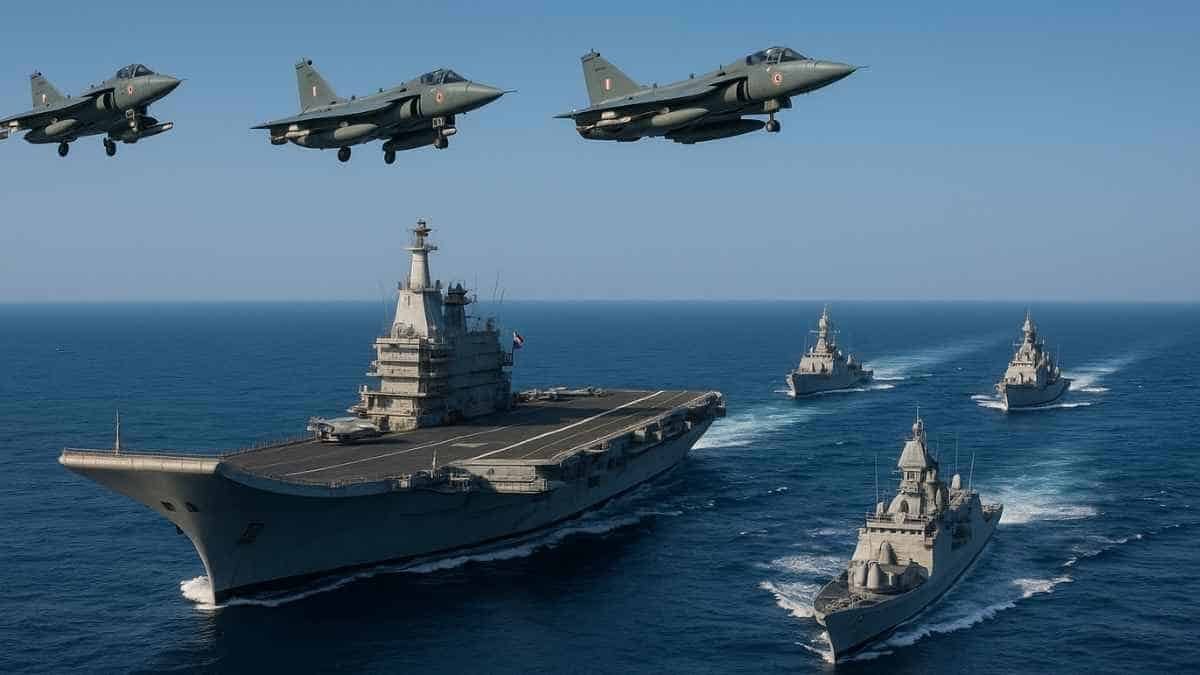

India’s defence landscape is witnessing a transformative moment, as September 25 brings with it a series of striking revelations across air, land, sea, and technology domains. From Russia confirming HAL Nashik’s readiness to switch to Su-57 production with minimal changes, to India’s ambitious plans for a nuclear-powered aircraft carrier by 2047, the day’s updates reveal a powerful narrative of rapid modernization, strategic foresight, and global positioning. In today’s Indian Defence News, the Defence Roundup spans the Indian Air Force’s Tejas MkII breakthroughs, the Navy’s carrier ambitions, indigenous drone expansions, futuristic defence facilities, and even AI-powered simulators redefining training for the next generation of warriors.
HAL Nashik Could Pivot to Su-57 Production with Minimal Tweaks
Russia has confirmed that the Hindustan Aeronautics Limited (HAL) facility at Nashik, originally built for Su-30MKI assembly, can transition to producing Su-57 fifth-generation fighters with only minimal modifications. This revelation, emerging during ongoing Indo-Russian defence industry dialogues, signals a possible leap in India’s aerospace capabilities. If implemented, it could place India among the few nations with licensed production access to stealth fighters.
Background: The Su-30MKI has been the backbone of the Indian Air Force (IAF) for over two decades, with HAL Nashik assembling more than 200 units. Transitioning from Su-30 production to a fifth-generation Su-57 line would mark one of the most dramatic industrial upscales in Indian aviation history.
Quick Fact: The Su-57, known in Russia as the Felon, can supercruise at Mach 2 and is designed for stealth and advanced electronic warfare.
What it Means: For India, this offers dual benefits: reducing dependence on foreign imports and bolstering airpower against regional rivals operating J-20 stealth fighters. However, cost-sharing, technology transfer, and integration with India’s indigenous AMCA program will remain critical negotiating points.
Tejas MkII Set to Exceed Design Expectations with Higher MTOW
India’s Tejas MkII fighter is moving beyond its original design expectations with reports that it will feature an increased maximum takeoff weight (MTOW). This enhancement, combined with more powerful GE-F414 engines, promises greater payload capacity, extended range, and superior multirole capabilities compared to earlier prototypes.
Background: The Tejas MkII program was greenlit to replace ageing MiG-29 and Mirage 2000 fleets. HAL and ADA engineers have continuously refined the platform to meet IAF’s frontline combat needs.
Quick Fact: The Tejas MkII will carry an MTOW of 17.5 tonnes, making it significantly heavier and more capable than the current Tejas Mk1A variant.
What it Means: For policymakers and the military, this represents a crucial mid-tier asset between Tejas Mk1A and the upcoming AMCA. Enhanced endurance and weapon load will enable the IAF to better manage a two-front conflict scenario, while strengthening India’s indigenous aerospace ecosystem.
India’s Ambition: Nuclear-Powered Aircraft Carrier by 2047
In one of the most ambitious announcements, a senior naval official has confirmed that India is eyeing a nuclear-powered aircraft carrier by 2047, coinciding with the centenary of independence. Tentatively referred to as INS Vishal, the project will rely heavily on advanced nuclear propulsion technology, electromagnetic launch systems, and drone integration.
Background: India currently operates INS Vikramaditya and the indigenously built INS Vikrant. Both use conventional propulsion, limiting endurance compared to nuclear-powered carriers like those operated by the US and China.
Quick Fact: Nuclear carriers can sail for 20 years without refueling, drastically increasing operational reach.
What it Means: For the Indian Navy, a nuclear-powered carrier symbolizes blue-water dominance, countering China’s growing naval ambitions in the Indo-Pacific. However, this will demand massive financial outlays and indigenous nuclear technology breakthroughs, aligning with India’s goal of strategic autonomy.
Armed Forces Expand Drone Fleet with 87 MALE UAVs
India’s armed forces are set to acquire 87 Medium-Altitude Long-Endurance (MALE) drones, marking a significant step in unmanned warfare capabilities. Defence analysts note this does not signal the end of indigenous drone programs like Archer-NG and Tapas but rather complements them.
Background: Global conflicts, from Ukraine to the Middle East, have demonstrated the decisive role of drones in modern battlespace management, intelligence gathering, and precision strikes. India has accelerated investments to bridge gaps with China and Pakistan.
Quick Fact: A typical MALE UAV can remain airborne for 24 hours, providing continuous surveillance over 1,000 km.
What it Means: This expansion reflects India’s determination to maintain persistent surveillance and strike capacity in border regions. It also shows how procurement is balancing imports and indigenous development, ensuring self-reliance without compromising on immediate operational readiness.
INS Vishal: India’s CATOBAR Ambition and UAV Carrier Debate
Debates within naval circles are intensifying over whether the proposed INS Vishal (IAC-3) should follow the CATOBAR (Catapult Assisted Take-Off But Arrested Recovery) model or evolve into a hybrid UAV carrier. Analysts argue that ISR and strike drone operations could redefine carrier warfare in the Indian Ocean.
Background: CATOBAR systems enable the launch of heavier aircraft, including airborne early warning (AEW) platforms, greatly enhancing fleet protection.
Quick Fact: China’s Fujian carrier is also CATOBAR-equipped, signaling the technology’s strategic relevance in Asia.
What it Means: Adopting UAV-centric designs could make INS Vishal a cost-effective game-changer, balancing India’s naval power projection with emerging drone warfare realities. This decision will shape India’s maritime doctrine for decades to come.
CRPF to Induct 200 Caracal Sniper Rifles for Counter-Insurgency
The Central Reserve Police Force (CRPF) will soon induct 200 Caracal sniper rifles, strengthening its counter-insurgency capabilities in Kashmir and other hotspots. The rifles, known for precision and lightweight design, are tailored for high-mobility operations.
Background: India’s paramilitary forces have long relied on Dragunov SVDs, many of which are ageing and lack modular upgrades. The Caracal acquisition reflects a shift toward modern, adaptable weapons.
Quick Fact: The Caracal CS50 sniper rifle is chambered for .50 BMG rounds, capable of penetrating armored targets at long range.
What it Means: This move boosts India’s internal security apparatus, signaling New Delhi’s intent to modernize paramilitary forces alongside the military. Enhanced sniper capabilities will improve effectiveness in asymmetric warfare scenarios.
Dassault’s Bold Pitch: Local Rafale Production with Indian Integrations
French aerospace giant Dassault has proposed establishing local Rafale production lines in India with deep integration of indigenous systems and future upgrades. This offer aligns with India’s push for defence self-reliance and offsets obligations under prior Rafale deals.
Background: India operates 36 Rafales, acquired under a €7.8 billion deal. The aircraft have proven their worth in high-altitude Ladakh deployments.
Quick Fact: Rafales delivered to India feature advanced Israeli-origin helmet-mounted sights and DRDO-supplied components.
What it Means: If approved, local Rafale production could rival HAL’s Tejas MkII in cost-effectiveness debates, while enhancing India’s export potential. It also signals Dassault’s determination to compete with US firms eyeing India’s fighter market.
Challakere to Host India’s First Integrated Defence Research Altitude Test Facility
By 2028, Challakere in Karnataka will host India’s first integrated altitude test facility, a massive boost for research in propulsion and aerospace systems. The facility will simulate high-altitude environments, critical for testing engines of next-generation aircraft like AMCA and Tejas MkII.
Background: India has long relied on foreign facilities for such advanced testing, slowing indigenous programs.
Quick Fact: Altitude test facilities can replicate conditions up to 20 km in atmosphere, crucial for validating propulsion performance.
What it Means: This investment underscores India’s maturing aerospace ecosystem, reducing reliance on external partners and accelerating timelines for indigenous fighter programs.
DRDO’s ISSA Hands Over Indigenous Pilot Simulator for AMCA and Tejas MkII
The DRDO’s Institute for Systems Studies and Analyses (ISSA) has delivered an advanced pilot simulator to ADA, designed to support development of AMCA and Tejas MkII fighters. The simulator integrates AI-enabled features for tactical training and system validation.
Background: Simulation technology reduces costs and risks in fighter development, offering developers critical data without relying solely on physical prototypes.
Quick Fact: India spends nearly 15% of its aircraft development budgets on simulation and systems analysis.
What it Means: This indigenous simulator strengthens India’s ability to refine its stealth fighter program without heavy foreign dependency. It represents a leap in India’s digital defence ecosystem, critical for advanced combat platforms.
Zen Technologies Unveils AI-Enabled Fast Attack Craft Simulator
Zen Technologies has revealed India’s first AI-enabled simulator for fast attack crafts, revolutionizing naval training. The system allows crews to replicate realistic combat scenarios, including swarm tactics and littoral warfare conditions.
Background: India’s fast attack craft fleet is essential for securing littoral zones, countering piracy, and intercepting asymmetric threats.
Quick Fact: Zen Technologies has previously developed simulators for tanks and UAVs, but this marks its first naval-focused AI system.
What it Means: By indigenizing naval training solutions, India reduces dependence on costly imports while preparing sailors for increasingly complex maritime security challenges.
Conclusion
Today’s Defence Roundup demonstrates India’s sweeping modernization drive: from the possibility of Su-57 production at HAL Nashik to ambitions of a nuclear-powered carrier, from expanding drone fleets to investing in indigenous simulators. Together, these developments underline a decisive shift toward self-reliance, strategic autonomy, and cutting-edge capability-building.