
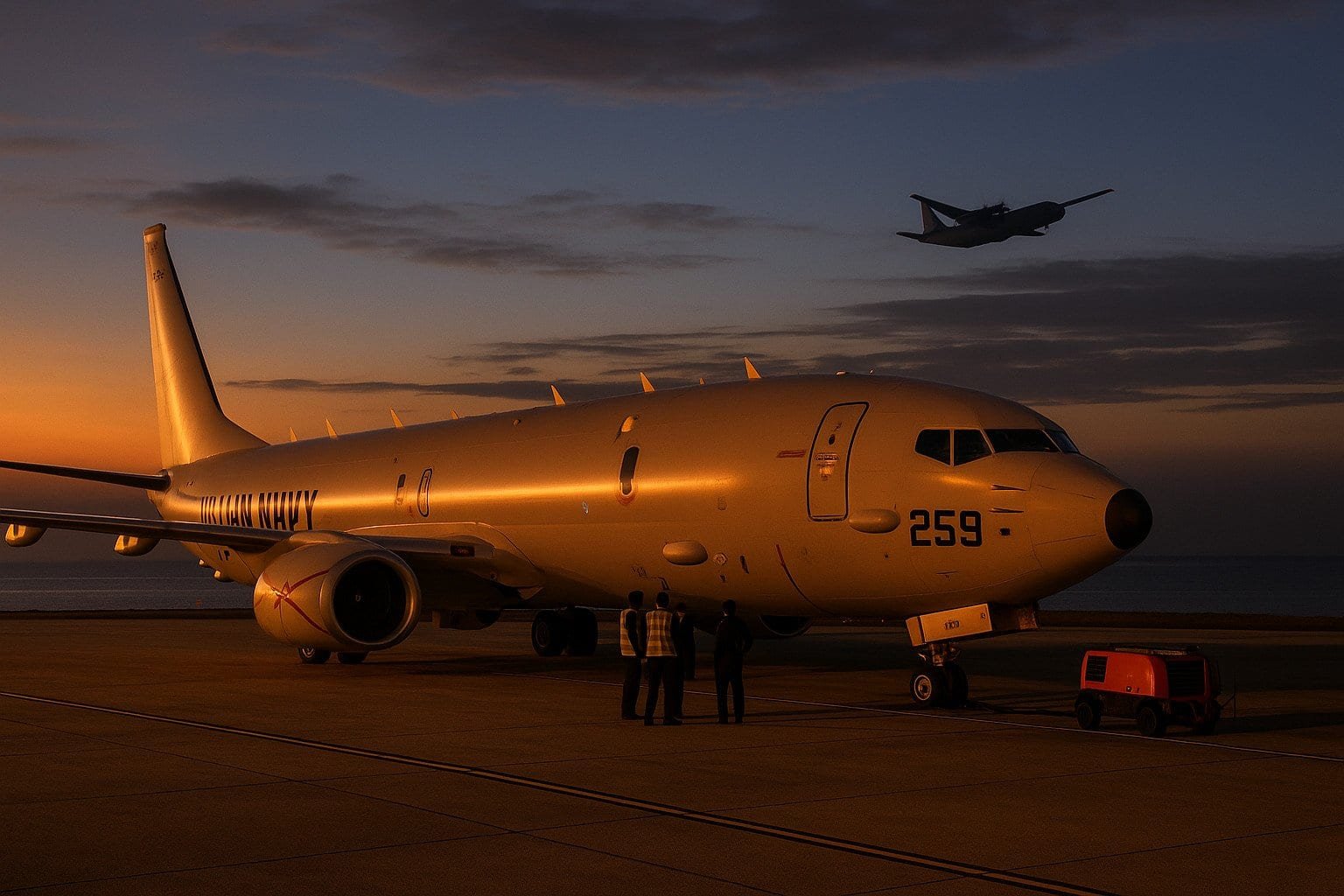

New Delhi, September 20, 2025: Welcome to DefenceBroadcast’s Daily Defence News Roundup, your quick, authoritative brief on the most important developments in Indian defence, the neighborhood, and global security. Today’s digest tracks India’s airborne surveillance push, a fresh impetus on indigenous missile production, a neighborhood procurement move that could shift local air-power balances, and a global naval deployment that matters for Indian sea lanes. In short: capability, readiness, deterrence—and why each update matters.
India Defence
IAF accelerates AEW&C expansion with indigenous Netra Mk II roadmap
The Indian Air Force has set an accelerated roadmap to field additional airborne early warning and control (AEW&C) aircraft under the Netra Mk II programme, aligning schedule, funding, and vendor workshares to bring new airframes into service this decade. The effort, being coordinated in New Delhi with DRDO and production partners, aims to close surveillance gaps across both western and northern sectors by improving endurance, sensor range, and networked datalinks. It matters because AEW&C platforms remain the critical “quarterbacks” for fighter control, airspace management, and missile-threat cueing. The plan advances through phased flight test points and progressive software drops so that operational squadrons can start training while later capability inserts (like ESM upgrades) continue in parallel.
Background: India’s first-generation Netra fleet proved the operational concept on a smaller airframe, while legacy Phalcon AWACS continue to anchor long-range coverage. Lessons from recent border standoffs underscored the value of persistent radar at altitude to detect low-flying threats and control interceptors in complex terrain. Netra Mk II, built on a larger platform, is designed to add range, endurance, and console capacity.
Quick Fact: AEW&C aircraft can extend a fighter’s “kill chain” by hundreds of kilometres simply by providing earlier detection and vectoring—often the difference between a reactive scramble and a planned intercept.
What it Means: For policymakers, this is a cost-effective way to multiply the value of existing fighters without waiting for entirely new fleets. For the IAF, earlier “eyes-out” warning compresses decision timelines and raises deterrence, especially when combined with integrated air defence networks and beyond-visual-range missiles. For industry, indigenous radar and mission-system work sustains a high-value electronics supply chain.
Indigenous missile production receives surge push for faster deliveries
The Ministry of Defence has approved a surge-production framework with state-owned and private partners to shorten delivery timelines for selected indigenous ground-based and air-launched missiles. The push, coordinated through production clusters in Hyderabad and Bengaluru, targets predictable quarterly output, longer-horizon component orders, and test-range slots booked well in advance. The rationale is straightforward: stockpiles and training rounds must keep pace with expanding force structure and the realities of high-tempo peacetime deterrence.
Background: Over the last five years, India’s missile portfolio has diversified—from short/medium-range surface-to-air systems to beyond-visual-range AAMs and precision surface-to-surface weapons. Export approvals for some systems have also opened, which is good for industry but puts pressure on domestic lines to meet both IAF/IA and overseas commitments.
Quick Fact: In modern air defence, the missile is only part of the cost; seekers, fuzes, canisters, and built-in test equipment often dominate lifecycle spending and schedule risk.
What it Means: Strategically, the surge model lowers the risk of temporary stock shortfalls during crises and allows the services to train with live rounds more frequently. Politically, it is a tangible Atmanirbhar Bharat deliverable—high-skill jobs and deeper vendor ecosystems. Militarily, predictable pipelines enable realistic force planning and reduce the temptation to ration training shots.
Neighbourhood (Pakistan, China, etc.)
Pakistan signals new fighter sustainment package as life-extension priority
Pakistan’s air force has initiated a life-extension and sustainment package for a cohort of frontline fighters, with inspections and upgrades slated at multiple bases through the coming year. The program bundles engine overhauls, radar maintenance, electronic warfare updates, and fatigue-life tracking into a single contract vehicle intended to raise availability rates without large new buys. The move reflects budget pressures and the need to maintain a credible air-policing posture while deferring major capital expenditure.
Background: Over the last decade, Pakistan’s modernization has alternated between block upgrades and limited new-build acquisitions, with logistical dependence on foreign suppliers remaining a persistent constraint. Economic headwinds have pushed the air force to squeeze more life from existing fleets while seeking targeted avionics refreshes.
Quick Fact: Availability—how many jets can actually fly today—often matters more than total fleet count on paper; sustainment is the lever that moves that number.
What it Means: For India, the signal is that the western air picture will remain a mix of legacy and incrementally modernized platforms rather than a sudden step-change. Strategically, it argues for steady Indian investments in sensors, AEW&C control, and beyond-visual-range weapons that exploit any readiness gaps. Politically, it suggests Islamabad will court external financing or offsets for future big-ticket buys, timelines for which may stretch.
China expands high-altitude logistics drills near the plateau
The PLA has expanded high-altitude logistics and air-mobility drills on the plateau, rehearsing rapid movement of light mechanized units, air-defence detachments, and medical evacuation capabilities to austere forward strips. The exercises, observed over recent days, emphasize multi-domain integration—ground movement under UAV overwatch and short-notice air resupply—to practice sustaining tempo at elevation. The “why” is to reduce friction in deployment under thin-air conditions where engines, people, and radios behave differently than at sea level.
Background: Following the 2020-21 Ladakh crisis, both sides accelerated habitat, roads, and airstrip improvements. China’s logistics learning curve at altitude has been notable, but the environment remains unforgiving, and sustained operations impose high wear on equipment and personnel.
Quick Fact: Aircraft performance can degrade dramatically with density altitude; take-off runs lengthen and payload margins shrink, driving specific tactics for fuel, cargo, and routing.
What it Means: India must continue its parallel investments—winterised accommodation, pre-positioned spares, and high-altitude UAV reconnaissance—while leveraging terrain familiarity. Strategically, logistics drills are deterrence messaging as much as training; the best counter is visible Indian readiness and seamless jointness.
Global Defence
Indian Navy tracks expanded coalition patrols in the western IOR
Coalition navies have expanded coordinated patrols across key sea lanes in the western Indian Ocean Region, with India’s Navy synchronizing information sharing and independent deployments to maintain maritime domain awareness. The effort covers choke points, trade arteries, and areas impacted by recent incidents targeting merchant shipping. India’s role blends presence patrols, white-shipping agreements, and cueing from space-based surveillance to provide timely advisories to flagged vessels.
Background: The western IOR has repeatedly seen piracy cycles, proxy attacks, and grey-zone harassment of commercial shipping. India has historically shouldered a disproportionate security load in these waters given its trade dependence and proximity.
Quick Fact: Nearly 80% of India’s crude imports transit the Arabian Sea; even brief disruptions ripple across prices and logistics.
What it Means: Strategically, a steady operational tempo communicates that sea lanes remain open. Politically, coordination with partner navies strengthens India’s profile as a net security provider. For planners, the take-away is continued investment in P-8I surveillance sorties, unmanned surface/undersea systems, and satellite maritime analytics.
European defence budgets lock in multi-year spending floors
Several European states have passed multi-year appropriations that lock defence outlays at or above two percent of GDP, converting annual political pledges into binding medium-term plans. The budgets cover air defence, munitions stockpiles, and naval recapitalization, responding to prolonged conflict dynamics and alliance burden-sharing debates. Implementation is staged to relieve industrial bottlenecks—long-lead items like air-defence missiles and artillery shells receive early down-payments.
Background: Since 2022, European militaries have scrambled to rebuild inventories, only to run into capacity ceilings at factories that had atrophied. Multi-year contracts give industry enough certainty to add shifts, machines, and suppliers.
Quick Fact: Ammunition lead times are often measured in quarters; propellant chemistry, metal forging, and quality control each gate throughput.
What it Means: For India, a tighter global market for missiles and shells reinforces the logic of domestic capacity building. Strategically, sustained European demand may keep prices high and queues long, nudging New Delhi further toward indigenous lines and smart stock management.
Asia-Pacific air forces emphasise tanker and transport buys
Air forces across the Asia-Pacific are prioritizing aerial refueling and strategic transport, signing for tankers and heavy lifters to extend fighter range and move troops at tempo. Announcements and RFP activity in recent weeks underline a regional recognition that strike aircraft without legs and logistics are of limited value over oceanic distances. The acquisitions bundle training simulators and maintenance packages to ensure availability.
Background: The Pacific’s tyranny of distance turns every sortie into a fuel-management problem. India’s own experience has shown how a limited tanker fleet can become the bottleneck for otherwise capable fighters.
Quick Fact: A single modern tanker can “create” multiple fighter sorties by topping up jets en route and on return, multiplying presence without basing rights.
What it Means: For New Delhi, tanker/transport capacity remains a quiet but decisive enabler for airpower across two fronts and the IOR. Investments here pay off across disaster relief, HADR, and evacuations—missions that carry diplomatic resonance.
Missile-defence testing tempo rises across multiple regions
Multiple states have conducted developmental and user trials of air and missile-defence interceptors, validating seekers, command-and-control, and network integration. The tests, spread over different ranges, are part of a broader global move to re-stock and modernize ground-based air defence after recent conflicts exposed shortfalls. Trials also included system-of-systems exercises where radars, shooters, and decoys were flown in realistic sequences.
Background: From drones to cruise missiles, layered air defence has become the organising principle of national security. India’s path mirrors this with upgrades to indigenous systems and integration with airborne sensors.
Quick Fact: In many systems, software and data-links account for more of the complexity than the missile airframe itself—latency and track fusion are the hard problems.
What it Means: For India’s planners, the lesson is to treat networks as weapons. Funding should keep pace not just for interceptors but also for the digital plumbing that makes them effective at scale.
Defence industry consolidations target avionics and EW niches
A wave of mergers and strategic partnerships is reshaping global defence supply chains, with specific focus on avionics, electronic warfare, and power electronics. Firms are bundling IP and production capacity to compete for multi-year programs in AEW&C, UAVs, and smart munitions. India’s vendors are being courted as co-development partners in subsystems where domestic capabilities have matured.
Background: After years of fragmentation, prime contractors are pulling critical tier-2/3 suppliers closer to secure schedules and margins. For emerging markets, it opens windows to slot into global programmes.
Quick Fact: EW racks and mission computers can drive as much as a third of a modern aircraft’s programme cost over its life.
What it Means: Indian companies with proven reliability stand to gain export revenue and experience—if they meet quality and cybersecurity bars. Strategically, selective alignment with trusted partners can accelerate domestic programmes without surrendering control.
Space-based ISR enters a higher-cadence era
Governments and commercial constellations have increased revisit rates for electro-optical and radar satellites, delivering more frequent tasking over strategic corridors. For India, access to multi-spectral imagery and change-detection analytics is improving maritime watch, border monitoring, and disaster response. Tasking, collection, processing, and dissemination pipelines are being streamlined so that commanders can act on insights within operationally meaningful windows.
Background: The last few years saw geospatial intelligence move from occasional snapshots to near-continuous awareness. Synthetic aperture radar has been particularly valuable under cloud and at night.
Quick Fact: With modern tasking, a single corridor can be imaged multiple times per day at useful resolution, enabling pattern-of-life assessments rather than isolated pictures.
What it Means: For India’s joint planners, tighter coupling of space data with air and naval operations is the next frontier. The payoff is fewer surprises and faster, cleaner decision-making loops.
Conclusion
Today’s Defence Roundup underscores how India’s security posture blends near-term readiness with long-term capacity building. AEW&C expansion and missile-production surge plans speak to immediate operational needs; neighborhood moves, and PLA logistics drills remind us that deterrence is a lived, daily practice; and global shifts in budgets, industry structure, and space-based ISR will shape the strategic environment India must navigate. For readers tracking Indian Defence News Today and Global Defence, the through-line is clear: capability multiplied by networks—and timelines that actually deliver.